Tuesday, June 7, 2011

Hillary’s Smart Power and a "Golden Age for Philanthropy in Turkey"

By Ayca Ariyoruk

Hillary Clinton wants to put diversity into work. That’s why in May, she brought together hundreds of first, second-generation Americans or Americans-to-be at the Secretary’s Global Diaspora Forum in Washington DC. If you are, like me, thinking, “We don’t want anything to do with the place we come from. They will never resolve their differences, and it is a waste of our time. We can’t possibly make any contribution,” as Clinton put in her own words, read on because Madame Secretary respectfully disagrees with you. She may convince you otherwise. She convinced me.

Currently, more than 60 million Americans are first or second generation Diasporas in America. America ranks first among countries with the largest number of international migrants, not a surprising fact given almost all Americans have immigrant roots further back. 60 million is a lot of people, makes up a population comparable to that of a mid-size country. A “potential” as Secretary Clinton calls it and a key tool in America’s national strategy of employing smart-power. Harvard Professor Joseph Nye defines smart power as the strategic use and choice of hard power –military, economic means or soft power –culture, values, policies and institutions, for a winning strategy. In other words knowing which power to employ and when.

“Using people-to-people exchange is the core of smart power” Clinton says, the Peace Corps, US Agency for International Development, Overseas Private Investment Corporation and the State Department “all rolled into one.”

She is not kidding. $46 billion is the amount of remittances sent by US Diaspora in 2010, according to the State Department, almost twice the $28.7 billion US Official Development Assistant in 2009. The term ‘remittances’ generally refers to transfers in cash or kind from a migrant to household resident, in the country of origin, such as a worker’s remittance.

Yet it is not just about money and how much Diaspora sends back. The hearts and minds engaged for the good of the people in the homeland, also known as the Diaspora Philanthropy, counts more. Let’s not forget, philanthropy is different from charity. Philanthropy refers to seeking out the root causes of problems and solving them. It is transformational giving aimed at bringing about social change and influencing policy. Now-a-days, you can’t win wars only through military means, nor can you build peace-loving democracies with healthy economies solely on foreign aid. That’s where Philantrophy, or smart-charity as I would like to call it, comes in.

For instance, Turkish Philanthropy Funds (TPF) offers leadership, skills and networks to increase access to education in Turkey and to empower women in exercising economic control over their lives. TPF does that by connecting members of the Turkish-American Diaspora community to innovative causes in Turkey. More than your money (simple in-cash donations are always welcome), TPF needs your ideas and your skills. As the only speaker from the Turkish-American community at Secretary’s Diaspora forum, Ozlenen Eser Kalav, TPF’s president explains TPF’s unique model on giving: “TPF does not approach Diaspora philanthropy as a matter of quantity. We pay special attention to donors’ involvement…”

The Turkish-American community is a predominantly immigrant community. Only 25 percent of the Turkish-Americans living in the United States are US-born. Bonds to Turkey still fresh, we are conscious of our ethnic ties. Most of us came to the US from middle-income families to advance in our educations, not out of desperation. We reached a point where we can think about giving back to larger communities in Turkey, having an impact beyond the small family unit. That’s why since its inception in 2007, TPF was able to grant over $10.4 million to Turkish and US non-profits. Over 1,200 students, women, children and their families have benefited from TPF funded programs.

Turkey’s growing economy makes it a perfect place to invest in new ideas and networks, the bread and butter of philanthropy. The economy is ripe and can produce wealth and nurture entrepreneurship, innovation, paving a path for which Michael Green describes as the “golden age of philanthropy” in Turkey. He has a point. A decade of robust growth placed Turkey among the top 20 economies of the world. Yet, like many other countries, Turkey is unevenly affected by the forces of globalization which is for the most part responsible for this notable growth. While some populations in the society are moving ahead and are placed above the curve, some are falling behind considerably.

If you are now a new convert, like me, who thinks making a difference in Turkey is possible, write to us, about your ideas, your passion, and together we will find ways to be smart about it.

Ayca@tpfund.org.

Ayca Ariyoruk joined Turkish Philanthropy Funds as Director of Communications and Outreach in May of 2011. She will be a regular contributor to TPFundBlog bringing you stories on philanthropy and global development.

To receive blog posts, please Sign-Up

Wednesday, May 25, 2011

TPF Founders Receive Global Citizenship Award from Turkish American Business Forum


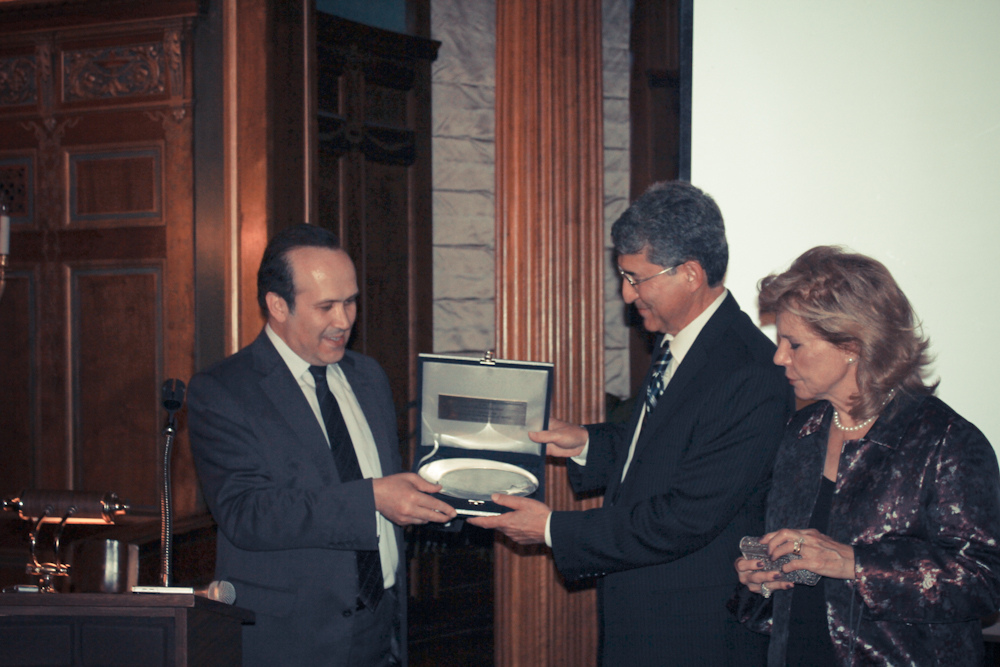
Turkish Philanthropy Funds Founding CEO and President Ozlenen Eser Kalav and Founding Chairman Haldun Tashman were honored with the Global Citizenship Award at the 9th Annual Turkish American Business Forum Gala on May 19, 2011.

The Global Citizenship Award recognizes individuals for their global perspective, commitment and contributions to education and philanthropy. Haldun Tashman and Ozlenen Kalav were the first recipients of this special award and hope to set an example for future generation of Turkish-Americans to give back to their community.

Hamdi Ulukaya, Jan Nahum, Lawrence M. Kaye, and Cenk Uygur were also honored by the Turkish American Business Forum at the Gala this year.


Thursday, May 19, 2011

TPF Honored by H.E. Ambassador Namik Tan

Turkish Philanthropy Funds was honored for its humanitarian efforts at a reception hosted by H.E. Ambassador Namik Tan, Turkish Ambassador to the U.S. and his wife at the Turkish Embassy Residence in Washington D.C. on May 16, 2011. The Ambassador and his wife hosted prominent members of the Turkish-American community, leaders from the nonprofit circle and government officials to celebrate TPF's efforts in advancing community development in Turkey.

TPF Founding Chairman, Haldun Tashman spoke briefly about TPF's journey since its inception in 2007 and stressed the importance of building a community through joint efforts.


More Pictures.

Monday, April 25, 2011

Landmines Are Not an Issue of Security but Rather an Issue of Human Rights

By Ozlem Ozturk

Toplumsal Duyarlilik Dernegi (Association for Social Awareness)

Children don’t play soccer or tag in southeastern Turkey. They wish they did. But the several thousands of landmines that are scattered across over 3,000 villages won’t allow them. According to the Turkish-based Human Rights Association, and Association for Social Awareness (ASA), the regions of Mardin, Sirnak, Hakkari, Siirt, Diyarbakir, Bitlis, Batman, Van and Bingol are especially overrun with landmines.

Landmines were planted as a result of an intense conflict in Turkey’s southeast over the past several decades. Both Turkish government forces and opposition rebels are guilty of planting the deadly weapons. Landmine Monitor estimates that over 930,00 mines were planted between 1957 and 1998.

Though the number of landmines in Turkey is grossly high, there is little information about them. There are no studies, research or evaluation about the risks of unexploded mines. Moreover, there are no laws on behalf of mine victims.

Since June 2008, as ASA, we have been fighting to eliminate landmines and raise awareness to protect the public. We are committed to making landmine awareness a human rights issue that the Turkish government needs to tackle. Toward that end, in 2006, we conducted a survey in Hakkari, collecting data about unexploded mines and information about those injured by mines. From 2006 to 2007 we rolled out a “Therapy and Prosthetics Project” that provided prosthetics to 65 landmine victims. It culminated in the publication of a book entitled Geride Kalanlar.

These efforts have shed much needed light on the plight of those living in the southeast of Turkey, often under harsh conditions of poverty, gender inequality and poor education. Organizations such as Turkish Philanthropy Funds are critical in helping move our efforts forward.

One of those efforts has been the “Mine and Conflict Waste Education for Children” program. Piloted in Hakkari, this program aims to reduce the risk of harm that unexploded landmines can have on children. The project is currently run in public elementary schools where children between 7 and 15 learn about the dangers of landmines and other explosives. It’s touched 20,000 in Hakkari. Since the program started there have been no landmine accidents.

Visit TPF Website

Monday, April 4, 2011

Will Bill Gates and Warren Buffett visit Turkey?

By Michael Green

Is giving America’s new big export to the world? Bill Gates and Warren Buffett certainly hope so. Last month they visited India on their second foreign expedition, after a trip to China at the end of last year, to promote their ‘Giving Pledge’ – a commitment by billionaires to give away at least half of their wealth. The idea has certainly taken off back home, where one in ten of America’s super-rich have signed on the dotted line. Could Turkey be next?

Critics have been quick to point out that the ‘Giving Pledge’ tours have not been a rip-roaring success. In China Buffett and Gates got a pretty indifferent response, in public at least, and none of India’s economic winners has yet signed on. This is no surprise say some who think that philanthropy is a curiously American habit that is inappropriate in countries with different cultures and social models.

Yet philanthropy is not an alien concept outside America. In India in particular there is a rich tradition of giving, as Gates acknowledged on his visit, that goes back centuries and lives on today through the philanthropy of people like Ratan Tata, the head of the giant Tata industrial group.

Indeed, rather than being a call to action to overseas billionaires, the Giving Pledge tour is better understood as an acknowledgement of a trend that is already underway. In both India and China the fundamentals are in place for a boom in giving – a new generation of entrepreneurial wealth-creators and countries with plenty of tough challenges ahead as they try to turn soaring economic growth into sustainable and equitable development for their societies.

America was already exporting the idea of high-impact philanthropy long before Gates and Buffett set off on their tour – through successful Chinese and Indian Americans giving back to their countries of origin. Take Vinod Khosla for example. Born and raised in India, he earned his fortune in venture capital in California and is now applying his business skills to his giving back in his home country through a series of investments in ‘social’ businesses like the microcredit provider SKS.

Such diaspora philanthropy is a growing trend in its own right. Migrants have always been generous in supporting their families and communities at home – according to the World Bank global remittance flows are now far greater than official aid from the governments of rich countries. But it’s not just about the cash. From Haiti to India, diaspora philanthropists are getting increasingly well organised and focused on making sure that their giving is more than expression of concern but a real force for change.

The Turkish economy is certainly producing the entrepreneurial wealth to fuel a golden age of philanthropy. Maybe, with the help and leadership of the diaspora, Turkey might soon merit a visit from Messrs Buffett and Gates.

Michael Green is the co-author, with Matthew Bishop, of Philanthrocapitalism: how giving can save the world

Visit TPF's Website.

Tuesday, March 22, 2011

Turkish Trains and the Lessons for Philanthropy

By Stephen Kinzer


I am writing this while speeding across the verdant Anatolian plain on Turkey's first high-speed train, which began operating two years ago. The Spanish-made cars are sleek outside and immaculate inside. Seats are comfortable, the ride is smooth, and attendants have just served tea and snacks.

This project reflects what works well in powerful emerging-market countries like Turkey—and also what works less well. It holds lessons for philanthropists as well as for entrepreneurs.

The train line was built by one of Turkey's most successful infrastructure companies, the Alarko Contracting Group, which has a global reputation for excellence in building large infrastructure projects. Among its current ones are an airport in Kiev, light rail systems in the Turkish cities of Samsun and Adana, and a water purification and distribution system in Astana, the new Kazakh capital.

Alarko was built largely by a visionary entrepreneur, Ishak Alaton. In the 1940s his family, like many Jewish families in Turkey, was effectively bankrupted by a one-time “wealth tax” that fell disproportionately on non-Muslims. The young Ishak Alaton was undaunted. He chose an equally ambitious partner and, starting from scratch, built his company. For decades he has also worked to promote civil society and human rights in his homeland.

Turkey spent much of its national life isolated from the global economy. That began to change in the 1980s, but the economy remained volatile and subject to sudden crises. Then, in 2002, Turks elected a single-party government that has made Turkey's economy one of the world's most vibrant. Last year it grew by an astonishing 11 percent, second only to China.

One of the government's priority projects was building a high-speed rail line from the capital, Ankara, to the largest city, Istanbul. Working with a Spanish partner, Alarko completed the first leg, from Ankara to the city of Eskisehir, in two and a half years.

This is not an ultra-high-speed “bullet train,” but a conventional fast one like the Acela, which serves the Boston-New York-Washington corridor. The 125-mile trip from Ankara to Eskisehir takes 87 minutes. A trip of about the same distance, from New York to New London, Connecticut, aboard the Acela, which is the fastest train in the US, takes 135 minutes.

All of this is good reason for Turks to celebrate, but also to worry. The new train line reaches only to Eskisehir, and progress toward finishing the route to Istanbul is slow. Neither Alarko or another comparably qualified company has been given the contract to complete it. No official reason has been given, but in Turkish business circles, many say that whoever wins the contract is being expected to make “special arrangements” with government agencies or officials. They may range from bribes to shady side deals benefiting favored subcontractors. Alarko is known for its resistance to such “arrangements.”

When the contract for the first leg of this train line was awarded, Turkey's one-party government was reveling in its reputation for vigor and honesty. In recent years, that reputation has begun to fade. Entrepreneurship works only in a clean political environment. So does philanthropy. Both require cooperation with government, but when that cooperation becomes tinged with corruption, nations and individuals lose.

Stephen Kinzer is an award-winning foreign correspondent who has covered more than 50 countries on five continents. Kinzer spent more than 20 years working for the New York Times, most of it as a foreign correspondent in several countries including Nicaragua Germany and Turkey. He is the author of several bestselling books including Crescent & Star:Turkey between Two Worlds and Reset: Iran, Turkey and America's Future.

Visit TPF's website.

Friday, March 18, 2011

The Marmara-Manhattan supports TPF's Japan Earthquake Relief Fund


The Marmara-Manhattan supports TPF's "Japan Earthquake Relief Fund" with a corporate gift and donating $2 for every booking till the end of March 2011.

We thank them for their generosity and leadership.

To learn about the "Japan Earthquake Relief Fund," visit here.